A closer look at DuPage County's proposed homebuyer assistance program, who could qualify, and the other opportunities worth knowing about BEFORE buying a home in Chicago's western suburbs.
I spend a loooooot of time talking with people who would genuinely love to buy a home BUT feel like they're perpetually one financial milestone away from making it happen.
Maybe you're paying $2,200 a month to rent in the city, trying to save for a down payment while simultaneously paying for, well, life!
Maybe you've finally gotten your student loans under control, your career is moving in the right direction, and you're beginning to wonder if homeownership is more realistic than you originally thought.
Or…. maybe you've owned a home before, you're starting over, and you assume anything labeled first-time homebuyer assistance has absolutely nothing to do with you.
Well, I have something I think is worth your attention!
DuPage County IS working toward launching a new homebuyer assistance program that could provide qualifying buyers with up to $30,000 toward the upfront costs of purchasing a home (YAY!)
While that number certainly deserves some attention, I do think the more valuable conversation is about understanding where that money comes from, how it works, who can actually use it, and what other financial opportunities might already exist that you haven't considered.
Because there's a surprisingly large world of homebuyer incentives out there. Between state housing agencies, county initiatives, local municipalities, participating banks, and even individual mortgage lenders, people can easily overlook opportunities simply because nobody ever explained that they existed.
So, naturally, we're getting into the weeds!
First, What Exactly Is DuPage County Proposing right now (Nov 2026)?
On November 10th, 2026, the DuPage County Board heard details of a proposed program called Local Advantage DuPage, which would allocate $5 million in county funding toward helping eligible residents purchase homes.
The county intends to partner with the Illinois Housing Development Authority (IHDA), which already administers homebuyer financing and assistance programs throughout Illinois (so the idea is state + county here).
Here's the interesting part: rather than designing an entirely new mortgage program, DuPage County wants to build upon IHDA's existing Access Home program, launched in March 2026.
Under the proposed structure, a qualifying buyer could receive:
Up to $15,000 from IHDA, through its Access Home down payment assistance program (state funding).
Up to $15,000 in matching assistance from DuPage County, through Local Advantage DuPage (county funding).
So yeah! That's a potential $30,000 toward qualifying down payment and closing costs.
But I want to clarify something very important before anybody starts mentally spending that money…
This is proposed assistance, not an approved $30,000 grant that buyers can simply collect.
The financing is expected to come in the form of interest-free, deferred loans secured against the property. Basically, the assistance would not require monthly payments while the loans remain deferred, but the balances would generally become repayable when you sell, refinance, or pay off your mortgage.
IHDA's portion would function as a second mortgage, with the county's contribution structured as a third mortgage.
And that distinction matters a LOT.
A $15,000 gift and a $15,000 interest-free loan are two different financial benefits. Both can be extremely helpful, particularly when cash is the biggest or only obstacle preventing somebody from purchasing, but they should not be confused with one another.
Here's how I would think about it: the program could help you get into a home sooner without having to save every dollar of the upfront purchase costs yourself. You still have to qualify for the mortgage, and you still need to plan for eventually repaying the assistance.
As of November 18, the county has NOT officially launched the program. Its fiscal 2027 budget is scheduled for consideration on November 24, with officials hoping the initiative could begin as early as December.
The original funding pool is also FINITE. If every recipient were awarded the maximum $15,000 county contribution, $5 million would theoretically support roughly 333 buyers. The actual number will depend on final funding allocations and award amounts.
County officials have already suggested demand could exhaust the available funding before the end of 2027.
You can read more about the proposal through NCTV17's reporting on the county board discussion and follow the official DuPage County legislative proceedings.
You Might Qualify Even If You've Owned a Home Before
This is one of the details I wish more people understood about first-time homebuyer programs!
In many mortgage and housing assistance programs, first-time homebuyer does not literally mean you've never owned a home in your entire life.
IHDA generally defines a first-time buyer as someone who has not owned a primary residence within the previous 3 years.
Meaning, if you purchased a condo in your twenties, sold it several years ago, and have been renting ever since, you may qualify under the program's first-time buyer definition!
If you're divorced and previously owned a home with your former spouse, the timeline of that ownership could matter, too.
Of course, there are nuances. IHDA considers the ownership history of legally married non-borrowing spouses, and other exceptions can apply to qualifying veterans or purchases within designated targeted areas. DuPage County's final matching-program guidelines will need to clarify exactly which exceptions it adopts.
For now, the county has outlined the following proposed requirements:
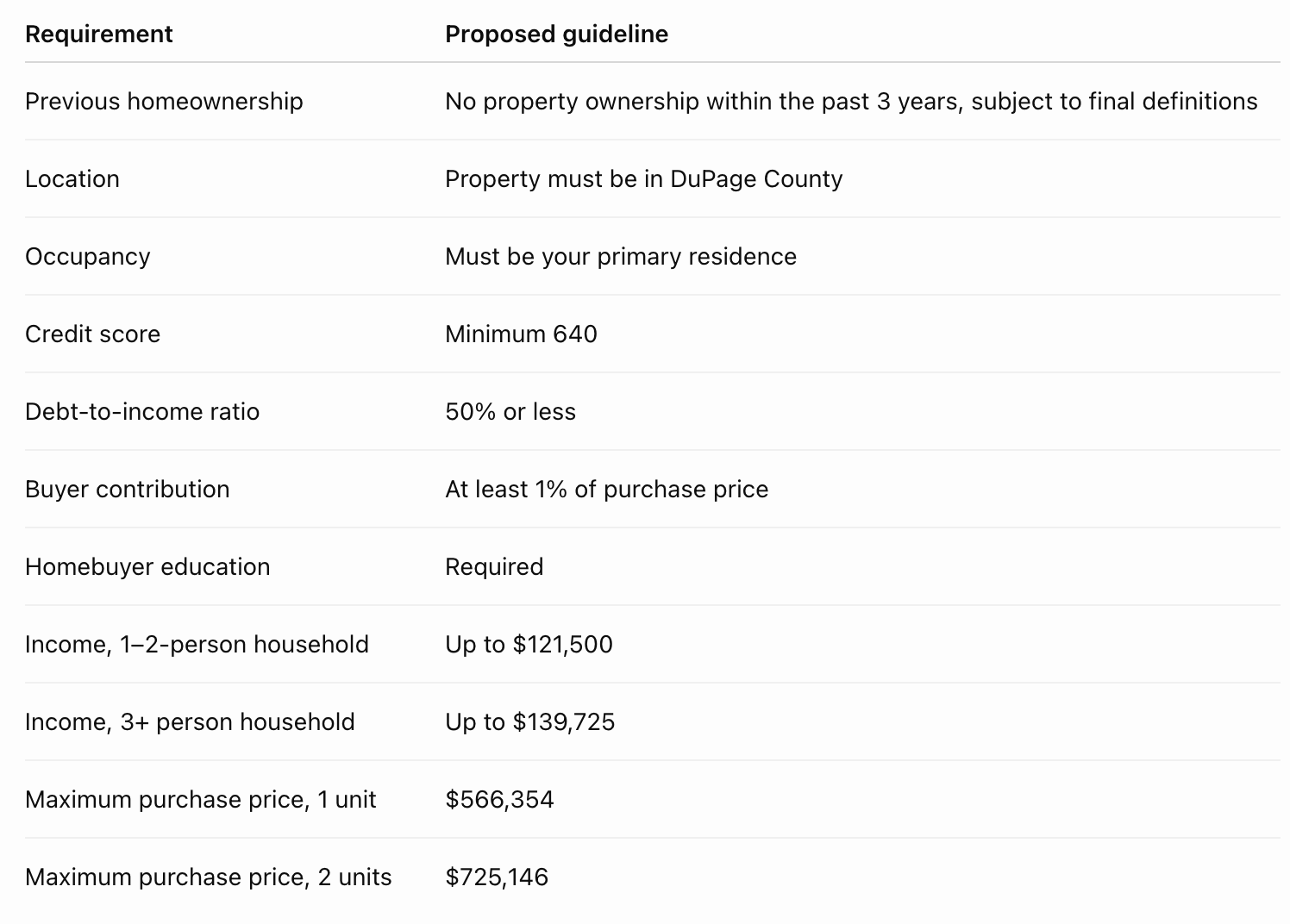
These figures reflect the proposal discussed in November 2026 and IHDA's existing Access Home guidelines. Final county terms, lender underwriting, and eligibility determinations may differ.
Now, a few things worth unpacking.
First: a single buyer earning $110,000 annually might reasonably assume they make too much money for a first-time homebuyer assistance program.
Under the proposed one- or two-person income threshold of $121,500, that buyer could actually fall within the program's income limit.
Of course, income eligibility alone doesn't guarantee loan approval. The lender still has to evaluate debts, credit, available assets, and the property's actual monthly ownership costs.
Second: being unmarried does not automatically help or hurt your eligibility. It depends on who is applying for the mortgage, who owns or previously owned property, and how the particular program determines income and household size.
For example, if you live with a partner but are the only person applying for the mortgage, IHDA's income calculation generally considers the income of borrowers obligated on the mortgage note rather than automatically counting every working adult living in the home.
That doesn't mean your partner's income can necessarily help you qualify for a larger mortgage without being a borrower. Those are separate calculations, and this is exactly why you want a knowledgeable loan officer reviewing your particular situation rather than relying on a generic online eligibility quiz.
And third, the program's income limits and its property price limits are completely separate hurdles.
You could meet every personal qualification and still find that the house you're interested in exceeds the allowable purchase price.
Which brings us to the part that gets particularly interesting when we look at DuPage County itself.
Where Can You Actually Buy a Home for Under $566,354?
Let's put this into local perspective.
According to Realtor.com's DuPage County market data, the county's median listing price was approximately $475,000 in its latest reported market snapshot.
That means the proposed $566,354 purchase-price ceiling IS above the countywide median listing price.
Encouraging, yes. But anyone who has searched for homes across DuPage County knows how dramatically pricing changes from one community to another.
Consider these reported median listing prices for selected local markets:
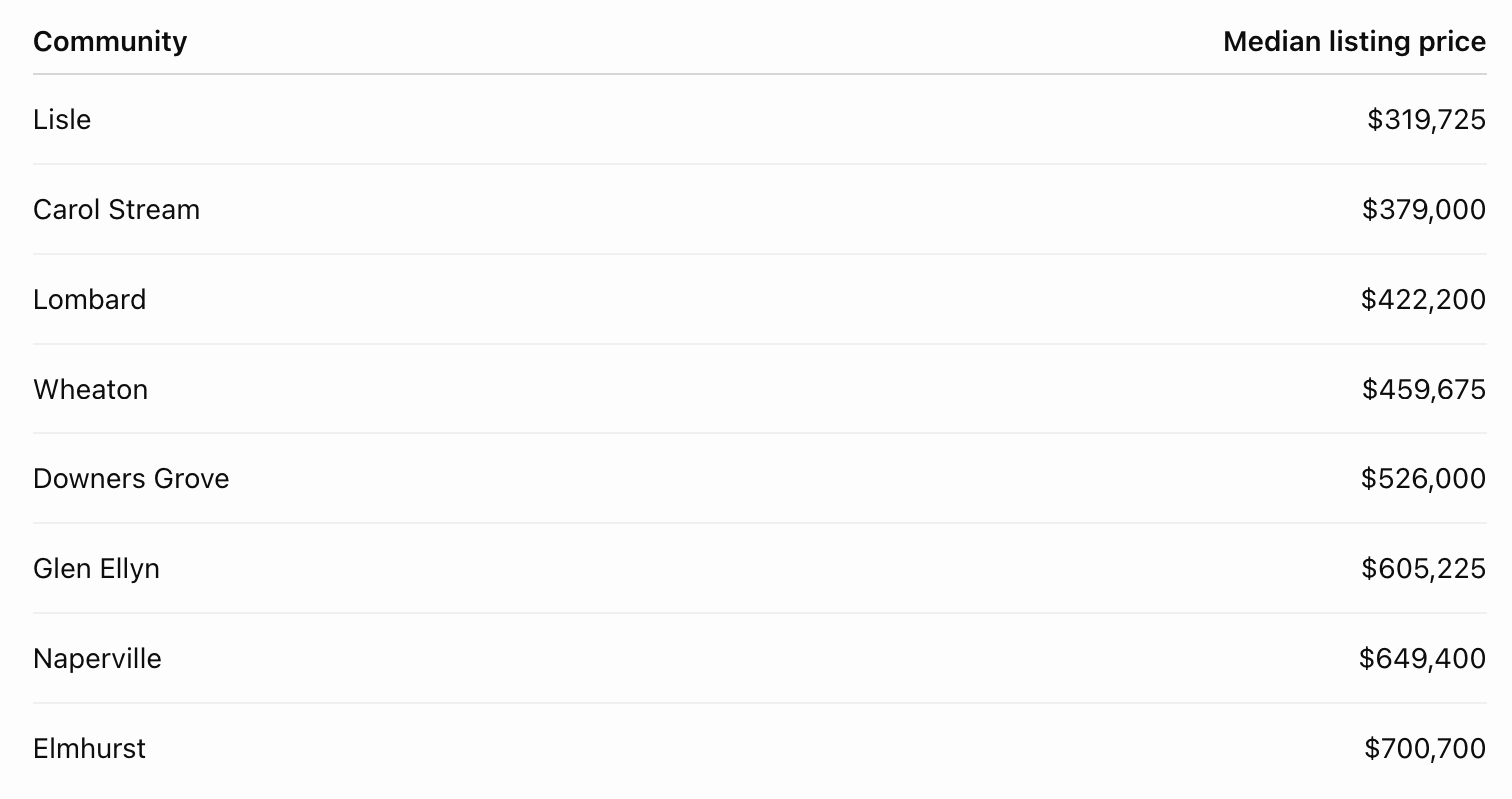
Source: Realtor.com local market data accessed November 18, 2026. Figures are market-wide medians, not eligibility determinations, and represent different mixes of housing types.
Now, before we cross Glen Ellyn, Naperville, or Elmhurst off anybody's list, remember that a median is just the midpoint of a particular set of listings.
A town with a $650,000 median asking price can absolutely have properties available for less than $566,354.
And a community with a $400,000 median doesn't necessarily mean you'll find a detached four-bedroom home with a finished basement, attached garage, and beautifully updated kitchen for that amount.
Housing type matters tremendously.
A buyer looking for a two-bedroom condo in downtown Glen Ellyn is shopping a very different segment of the market than somebody looking for a detached single-family home near Lake Ellyn.
Similarly, you might find that a townhome in Lisle, a condo in Wheaton, a smaller detached home in Villa Park, or an older single-family home in West Chicago offers a more realistic entry point into ownership than your original search criteria suggested.
This is also where I think being thoughtful about location can REALLY pay off.
You might begin your search exclusively in Naperville and ultimately discover that Warrenville, Lisle, or certain parts of Aurora offer the space, lifestyle, and accessibility you were hoping to find. Or you might be convinced that Glen Ellyn is outside your price range, only to realize there are homes within your budget when we start looking beyond the most competitive neighborhoods and property types.
One additional detail: a Naperville or Aurora mailing address does not automatically mean the property is located in DuPage County. Both cities extend into other counties. The exact property address matters, and we can verify it through the DuPage County property lookup.
The proposed county contribution would apply specifically to qualifying homes within DuPage County, so we want to establish that before assuming a listing is eligible. And because the proposal includes a higher price ceiling for qualifying two-unit properties, an owner-occupied duplex may be worth discussing for the right buyer. That comes with additional property, occupancy, financing, and landlord considerations, but it's an interesting opportunity that could easily be overlooked.
Now Let's Put Some Actual Numbers Behind This
Say you're considering a $450,000 home in Wheaton, IL.
You have stable employment, good credit, and enough income to support a mortgage.
You've been putting money into savings, but you're also trying to avoid completely draining your accounts just to get the keys.
Let's use a hypothetical conventional mortgage with a 3% down payment.
Your numbers might look something like this:
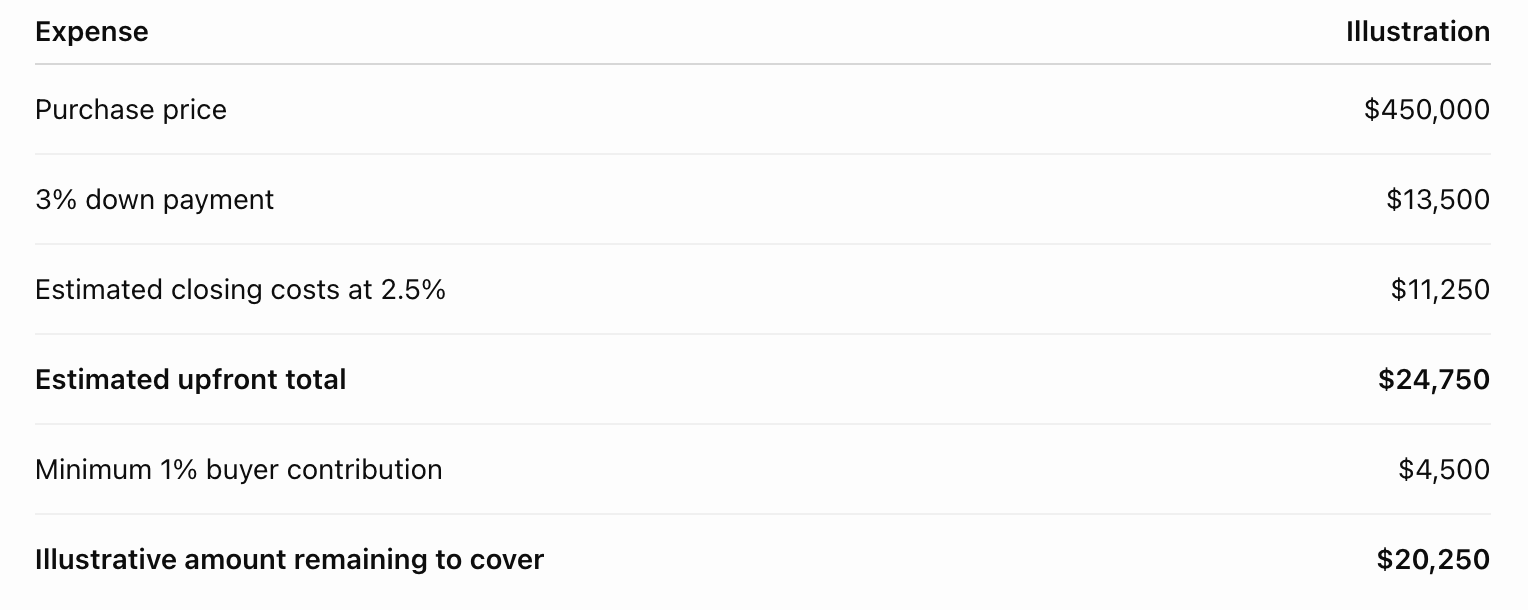
These are simplified estimates, not a lender's quote. Actual fees, prepaid expenses, escrow requirements, permitted assistance uses, and final cash-to-close figures will vary.
The Consumer Financial Protection Bureau notes that closing costs commonly range from 2% to 5% of a home's purchase price, separate from the down payment.
Now imagine qualifying for an assistance program capable of covering much of that remaining $20,250.
That could make a meaningful difference to your savings, your timeline, and how much financial breathing room you have after closing. Notice something else, though: in this example, the theoretical gap is $20,250, not $30,000.
Qualifying for a maximum assistance amount does not automatically mean you receive or get to keep every dollar of that maximum. The amount actually usable depends on eligible costs, your loan structure, required personal contribution, other credits, and the final program rules.
Any unused assistance is not simply handed over as extra spending money.
Now let's flip the scenario.
Perhaps you're purchasing a $550,000 house with a 3% down payment. That's $16,500 toward the down payment alone.
If your closing costs and pre-paids come in near $13,750, you're looking at roughly $30,250 before applying assistance or your required personal funds.
And then, after closing, the mortgage becomes only one piece of the monthly financial picture. There's the property tax bill, homeowners insurance, potential mortgage insurance, utilities, repairs, maintenance, and whatever that particular home is going to need over time.
For a condo or townhome, we also need to understand association assessments (HOAs), reserves, special assessments, and any restrictions relevant to the financing. That matters quite a bit in DuPage County, where property taxes can vary substantially between municipalities, school districts, and individual properties.
I care about getting my buyers into homes they love. I care just as much about what their financial lives look like after they move in.
An assistance program can make the upfront transaction easier without necessarily making the ongoing monthly payment affordable.
Which is why I'd rather spend an extra hour walking through the numbers than have somebody discover three months after closing that their monthly budget suddenly feels suffocating.
There Are Other Homebuyer Incentives Worth Knowing About, Too!
When somebody hears down payment assistance, they often picture one program, usually offered by the government, intended exclusively for people purchasing their very first home.
In reality, assistance comes from different institutions, for different reasons, with dramatically different repayment structures.
And the terminology alone can get totally confusing.
A grant generally provides financial assistance that does not have to be repaid if all applicable conditions are satisfied.
A forgivable loan starts as an obligation but can be forgiven gradually or entirely after certain requirements have been met, often involving the length of time you occupy the home.
A deferred loan postpones repayment, sometimes without charging interest, until a specified event such as a sale, refinance, or mortgage payoff.
A repayable assistance loan requires repayment according to an agreed schedule, potentially with zero or reduced interest.
There are also lender credits, seller concessions, builder incentives, and specialized mortgage products, all of which work differently.
For a local buyer, here are a few examples worth researching.
Illinois Housing Development Authority (IHDA)
IHDA offers several mortgage assistance options, not just Access Home. Depending on eligibility and availability, its lineup includes assistance of up to $6,000 through Access Forgivable, up to $7,500 through Access Deferred, and up to $10,000 through Access Repayable.
Each has different forgiveness, deferral, or repayment terms. You can review the IHDA mortgage programs directly.
Federal Home Loan Bank of Chicago: Downpayment Plus
Another program that deserves more attention locally is Downpayment Plus, offered through participating Federal Home Loan Bank of Chicago member institutions.
For qualifying households earning no more than 80% of area median income, the program offers up to $10,000 in assistance through a grant that is forgiven monthly over five years, subject to its requirements. The important detail here is that you're not necessarily applying directly to some giant government office. Access happens through participating financial institutions, which is exactly why the lender you choose can influence which programs you're able to explore.
Choose Aurora Homebuyer Assistance Program
Aurora is another great local example! The City of Aurora's Choose Aurora program offers income-qualified buyers assistance that can total up to $27,000, combining different forms of funding for eligible purchases.
The program includes deferred financing and grant components, with eligibility and funding availability determined by the city's guidelines. And unlike the proposed DuPage County initiative, this one is municipal. The home must fall within the applicable Aurora program boundaries. It's an excellent reminder that a buyer's options might change simply by crossing a city or county line.
Banks, Credit Unions, Lenders, and Homebuilders
Some financial institutions also have their own homeownership grants, community lending programs, or assistance initiatives.
Certain employers offer housing benefits, while homebuilders may offer closing-cost incentives or mortgage-rate buy-downs to encourage buyers to purchase in a particular development.
And then there's something I negotiate and evaluate with buyers regularly: seller concessions.
Depending on the circumstances, a seller may agree to contribute toward certain buyer closing costs. It's part of the contract negotiation, not a government grant, and it must comply with the relevant loan guidelines.
All of this is why I never want somebody assuming that the mortgage with the lowest advertised down payment requirement is automatically their best financial option.
And importantly, these incentives cannot all necessarily be combined. Some programs allow assistance from multiple sources; others prohibit certain combinations or impose limits on total financing and credits.
A good loan officer can help establish which combinations are actually permitted before you build your plans around them.
Free Money, Cheap Money, and the Cost of Financing
I want to add one more layer to this conversation because I think it's where people can make expensive assumptions (I know, I know, I write nooooveeelllll posts, sue me).
When comparing loan options, the amount of assistance offered is only one part of the equation. We need to compare the interest rate, mortgage insurance, fees, repayment obligations, and the amount of cash required at closing.
So for perspective, let's use a purely hypothetical $400,000, 30-year fixed-rate mortgage.
At 6.25% interest, the monthly principal & interest payment would be roughly $2,463.
At 6.50%, that payment would be roughly $2,528.
That's about $65 more every month, or ~ $3,900 in additional payments over 5 years.
Those rates are examples, not current mortgage quotes, and the comparison excludes taxes, insurance, mortgage insurance, fees, and differences in principal reduction.
But I'm showing this because a financing program that helps significantly with upfront expenses could still have a different long-term cost than another available mortgage!
Sometimes preserving your cash IS absolutely worth it.
Sometimes a different loan structure, negotiated credit, or interest rate actually makes more financial sense.
And sometimes the best strategy is a combination of incentives that allows you to purchase while keeping enough in savings to feel comfortable.
The point is to compare actual numbers. The CFPB's Loan Estimate guide is an excellent resource for understanding how the different expenses and terms appear in a mortgage proposal (along with my fave loan officer: Mr Joey Giammarino - more on him below!)
Here's What I'd Do If Buying in DuPage County Were on My Radar
I'd start looking into these opportunities BEFORE finding the house.
Noooo… not after falling in love with a listing, submitting an offer, and discovering that the financing we hoped to use requires an approved lender, particular documentation, a homebuyer education course, or a funding reservation that hasn't been secured.
I would want to know whether I qualify under the program's income and ownership guidelines, what my actual purchasing power looks like, and how much money I should realistically plan to bring to closing.
I would also want to compare the program against other financing options rather than assuming the largest assistance figure automatically wins.
If your goal is to buy in Glen Ellyn, Wheaton, Lombard, Downers Grove, Naperville, Lisle, Elmhurst, or any of our surrounding western suburbs, there's soooo much value in understanding these kinds of possibilities EARLY. Even if you discover you're not eligible for this particular program, you may uncover another option that's better suited to your circumstances.
Here’s an early little holiday gift for you all:
While we're talking about financing, I have to give a well-deserved shoutout to Joey Giammarino, VP of Mortgage Lending at Rate.

Joey is truly one of one.
He’s become my go-to loan officer, and when I tell you he's somebody you want in your corner throughout the home-buying process, I mean it.
There is tremendous value in having somebody who will actually sit down, get into the details of your financial situation, explain your options, and help you understand the decisions you're making.
I LOVE working with people who take the educational side of this business seriously. Joey is absolutely one of them.
Whether you're purchasing your first home, returning to homeownership after a few years, or simply trying to understand how to make your money work more intelligently, having the right people involved early can make a world of difference.
I've written before about what I think buyers should know about purchasing a home in Chicago's suburbs, and this is very much part of that larger conversation.
There's sooooooooo much financial advice surrounding homeownership, but not nearly enough of it helps people understand which opportunities genuinely apply to them.
You deserve to know what's out there, what the fine print actually means, and how to make a thoughtful decision with the information in front of you.
And if you're considering purchasing in DuPage County, I'd love to help you explore that. We can talk through the towns, the numbers, the possibilities, and what you're hoping life in your next home will actually look like.
Because sometimes the difference between buying a home and continuing to wait isn't that you need to save another $30,000. Sometimes it's learning about an option you didn't know existed.
With love,
Amanda Lee Finck
Home With Amanda Lee | @properties Christie's International Real Estate
Information current as of November 18, 2026. Local Advantage DuPage is a proposal, not an active or guaranteed funding opportunity. Program guidelines, funding, eligibility, and mortgage terms are subject to change. All numerical examples are educational illustrations, not financing offers or guarantees of eligibility.
